My content may contain 3rd party affiliate links for products I use and love. If you take action (i.e. subscribe or purchase) after clicking one of these links, I'll earn some coffee money ☕ which I promise to drink while creating more helpful content.
Contents
No elements found...
Creatine and Brain Health After 50: What a New Study Found
Most of us associate creatine with building muscle. It's been a staple in gyms for decades, and there's plenty of research supporting its benefits for strength and exercise performance.
But lately, I've been looking into another side of creatine.
What might it do for our brain health after 50?
A new study published in July 2026 in Brain, Behavior, and Immunity offers an interesting clue. And while the research is still preliminary, it's another reason creatine deserves attention from those of us interested in healthy aging.
What Does Gut Inflammation Have to Do With Your Brain?
More than you might think.

Researchers have been studying something called the gut-brain axis and how it might affect brain health after 50. It's the communication network connecting our digestive system and our brain.
When chronic inflammation develops in the intestines, its effects may extend beyond the digestive tract.
That's what researchers at the University of Seville and collaborating institutions wanted to investigate.
They used a rat model of ulcerative colitis, a condition involving chronic intestinal inflammation, to examine what happened inside the brain.
Specifically, they looked at the hippocampus, a region important for learning and memory.
And they found some interesting changes.
The Male Rats Were More Vulnerable
You can insert your favorite feminist joke here.
Because while both male and female rats developed signs of inflammation in the hippocampus, the males experienced more significant damage.
Researchers observed changes in markers of nerve cell health and disruptions in the electrical activity that allows neurons to communicate.
The female rats showed inflammatory changes, too, but their brain cells were less affected by some of the damage seen in males.
That's an interesting finding, although humans might not respond the same way.
Then the researchers looked at what happened when the animals received creatine.
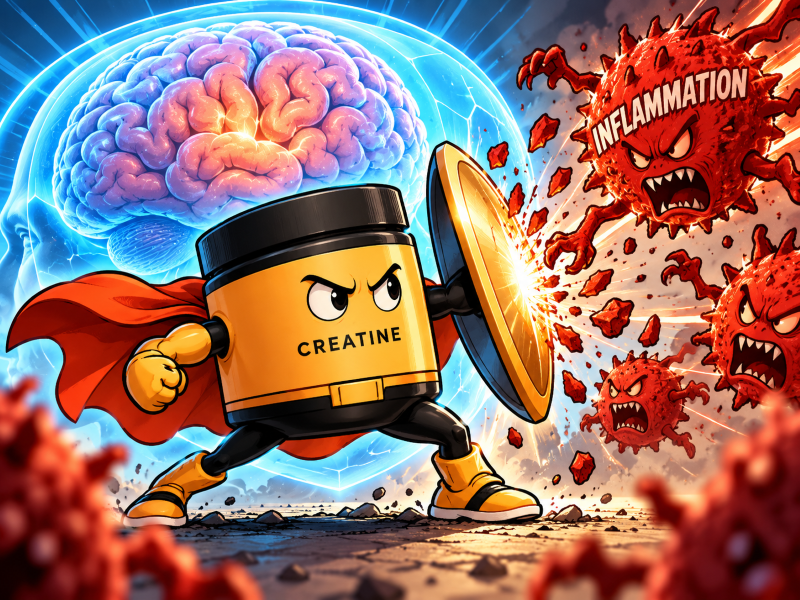
Creatine Appeared to Protect the Brain

The rats receiving creatine showed substantially less inflammation-related disruption in the hippocampus.
Researchers found that taking creatine:
One of the most interesting findings was that creatine appeared to protect the areas affected by inflammation without substantially changing healthy brain tissue.
That's encouraging, but let's remember that
This was an animal study, not a human clinical trial.
The researchers used a relatively large creatine dose in rats. Their results don't establish what dose would provide similar protection in humans, or even whether that protection would occur.
And the study didn't test whether creatine prevents ordinary age-related memory loss or dementia.
Those questions still need answers.
Why Creatine Might Matter Beyond Muscle

Creatine plays an important role in helping cells maintain their energy supply.
Our muscles use it, but so do our brains.
Brain cells require a bunch of energy to communicate, maintain their structure, and respond to stress.
Researchers are looking into whether creatine supplements can help support those processes, especially when the brain is under unusual demands.
This study adds another possibility: creatine may help protect nerve cells from certain kinds of inflammation-related damage.
That doesn't mean we should start calling it a brain-protection supplement.
But it does mean there's another promising area worth investigating.
The Bigger Picture for Those of Us Over 50
I've been taking five grams of creatine daily, primarily because I want to maintain muscle and strength as I age. Because of studies like this, I've upped that to ten grams (5 twice per day).
I want to stay active. Keep doing the things I enjoy. And avoid becoming physically limited any sooner than necessary.
But physical strength is only part of healthy aging.
I also want to keep my mind sharp.
That's why I'm increasingly interested in research looking at creatine's possible benefits for cognitive health.
We already have a good amount of human research supporting creatine for muscle performance, including benefits for older adults when combined with resistance training.
The research on brain health after 50 is less settled, but it's developing.
And studies like this one help researchers understand where to look next.
For now, I'm sticking with my creatine routine and following the science.
At our age, preserving what we've got is a pretty good investment.
Want to learn more?
Read my earlier article, Creatine Dosage After 50: Is 5 Grams a Day Enough?, where I look at some research on creatine dosing, muscle strength, and healthy aging.
Research reference: Ruiz-Calero A, et al. (2026). Modulating effects of creatine prevent sex-dependent hippocampal neuroinflammation, neuronal damage, and electrophysiological dysfunction induced by chronic colitis. Brain, Behavior, and Immunity, 138, 106929. https://doi.org/10.1016/j.bbi.2026.106929
This article is for educational purposes and isn't medical advice. Anyone managing kidney disease or another significant medical condition should discuss supplementation with their healthcare professional.
What Creatine Am I Using?
If you're considering adding creatine, or you're curious about the product I use, you can take a look here.
Take a Look at My Creatine
And if you have questions, my inbox is open.
