My content may contain 3rd party affiliate links for products I use and love. If you take action (i.e. subscribe or purchase) after clicking one of these links, I'll earn some coffee money ☕ which I promise to drink while creating more helpful content.
Contents
No elements found...
AI Bubble Meets 5% Bond Yields. Is Your Retirement Ready?
In the spring of 2009 I learned what it feels like when one thing breaks and drags everything else down with it. I was in real estate, and I thought I understood the risk. I'd been through the 18% mortgage rates in the 80's, the S&L bust in the 90's and never gotten more than a bloody nose. I thought I had it dialed in.
But when credit froze and the real estate bubble broke in 2008, everything I owned felt it at the same time, and I lost money I had spent years building. And the bigger problem for me was that I got hit hard enough that I didn't have the chips to get back in as the smoke cleared. I got creamed and lost my nerve for a long while.
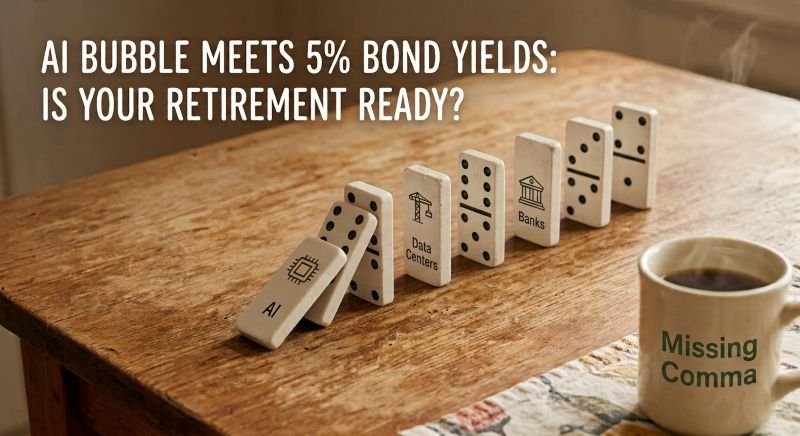
Right now there's a similar chain of dominoes lined up around what a lot of people are calling the AI bubble, and a few of those dominoes are already wobbling.
Even though the sellers of newsletters and advice claim they can, nobody can precisely time a crash. Even so, I've concluded that the risk is real enough that guys our age, who don't have 30 years to recover, should at least understand it. Here's the chain, link by link, with what's true and what gets over-hyped.
Link 1: AI spending is propping up the growth numbers

You may have seen the claim that an AI Bubble is driving 92% of U.S. economic growth. That number is real, but it's narrower than it sounds.
It comes from Harvard economist Jason Furman. He looked at the first half of 2025 and found that investment in information-processing equipment and software (think servers, chips, data centers) was only about 4% of the economy but accounted for roughly 92% of its growth. Strip it out and growth was close to zero.
Two yeah, buts: Furman said that without the AI boom, rates and electricity prices would likely have been lower, offsetting roughly half that effect. And Goldman Sachs' chief economist argued AI added "basically zero" to U.S. growth in 2025, because so many chips are imported.
My boiled down version is that a big share of recent growth leans on one kind of spending, and the biggest tech companies are on pace to spend $700 billion or more on it this year.
Link 2: That spending runs on borrowed money and cheap capital
Data centers cost a fortune, and a lot of the builders borrow to do it.
The problem is that money isn't cheap anymore. We've been living with artificially low interest rates for decades and that's coming to an end.

The 10-year Treasury yield crossed 5% in late September for the first time since 2007 and hit 5.34% on September 30, according to a Senate Banking Committee letter to Treasury Secretary Scott Bessent. The 30-year mortgage rate is back above 7.5%.
When borrowing costs rise, the weakest projects get delayed or canceled first.
We're seeing some of the concern hit the markets that the AI Bubble may be at risk of popping: last week the Nasdaq had its worst week since June, chip stocks fell nine days in a row, and CoreWeave, an AI cloud company carrying a lot of debt, dropped about 12% in one day.
A pullback would hurt the construction trades, but you'll see claims online that it would lay off "millions" of construction workers. That's probably an overstatement. The entire U.S. construction industry employs about 8.4 million people, and data centers are one slice of it. It would be a real hit to electricians, concrete crews, and the towns that bet on these projects, but probably not a nationwide wipeout.
Link 3: Your index fund is more exposed to the AI bubble than you think

Here's the part that hits our retirement accounts directly.
The information technology sector is now about 39% of the S&P 500, according to a July 2026 CME Group analysis. At the peak of the dot-com bubble in March 2000, it was about 33%. Some analysts who count every "AI-linked" company put the number at 45% or higher.
That means if you own a plain S&P 500 index fund, like most of us do, a big chunk of your money is riding on the same AI bet. You're diversified across 500 companies, but not across 500 different stories.
The last time the 10-year closed above 5%, in July 2007, the S&P 500 fell 19% over the next 12 months. That's one data point, not a law of physics, but it's worth knowing.
Link 4: The banks, and where the scary version goes wrong
Banks hold a lot of bonds. When interest rates rise, the market value of older, lower-yielding bonds falls. As of mid-2026, U.S. banks were sitting on about $327 billion in unrealized losses on their securities, per FDIC data. That's down from nearly $700 billion at the 2022–2023 peak, but that figure was measured before yields jumped another full point this fall. The next report, due in late November, will likely look worse.
Here's what the scary version skips. A bank whose bonds are worth less than its deposits is not automatically "out of money." Those losses are on paper, and if the bank holds the bonds to maturity it gets paid in full. The danger is when depositors all want their money at once and the bank has to sell at a loss.

That's exactly what happened to Silicon Valley Bank in March 2023.
Customers pulled $42 billion in a single day. About 89% of its deposits were above the FDIC's $250,000 insurance limit, so those customers had every reason to run. Two days after it failed, on a Sunday night, Treasury, the Fed, and the FDIC put out a joint statement that all depositors would be protected.
So yes, the "Sunday night everything's fine" press conference has happened before, and it could happen again.
Today it would come from Treasury Secretary Bessent and Fed Chair Kevin Warsh, who took over from Jerome Powell in May.
But there is a detail about how that story ended: insured depositors never lost a dime. And as of today, the FDIC's problem-bank list stood at just 47 banks.
The risk to regular savers isn't losing your insured deposits. It's the market panic that comes with the headlines.
What guys our age can do this week
I'm not a financial advisor or a registered rep, so I can't tell you what to do with your money. Here's what I'm checking in my own accounts.
Check your bank balances against the $250,000 line.
FDIC insurance covers $250,000 per depositor, per bank, per ownership category. If you're over that at one bank, spreading it out removes the worst case entirely.
Look up how much tech is really in your accounts.
Look at your index funds' sector breakdown, then add any individual tech stocks on top. My company 401(k) doesn't offer a lot of variety other than total market indexes, so my exposure is pretty high. I'm over 59 1/2, so I'm moving half the money I have in those funds to Dividend Aristocrat ETFs. I'm also increasing the percentage of my holdings in gold, silver, and crypto to 20% from my current 10%. I'm betting most of us will find the number is higher than we assumed.
Know what your bond fund will do.
Rising yields hit bond funds too. Find your fund's "duration" on its fact sheet. A rough rule: a duration of 6 means the fund drops about 6% for every 1-point rise in rates. If you're within five years of retirement, that number matters.
Have one to two years of withdrawals somewhere boring.
The worst thing in a downturn would be being forced to sell stocks at the bottom to pay the bills. That's what wrecked a lot of people in 2009, me included. A cash cushion buys time. It's also why I plan around a 3.3–3.5% withdrawal rate instead of the classic 4%. If things are juicy and I can draw more, super. But for planning, I want lots of margin for error.
Don't make big moves on headlines.
If you sold everything in March 2009, you missed one of the longest bull markets in history. The goal is to be positioned so a crash doesn't force your hand. As a side note, my move into dividend ETF might look like a move against this advice, but I've been reading these tea leaves for almost a year and have been considering a transition to a more income balanced porfolio for some time. So while the headlines are certainly part of it, It's been in the works for a while.
The bottom line
This chain has a real chance of playing out, and some links are already under strain. But "real chance" isn't "certain," and most online versions skip the guardrails that exist. Your job isn't to predict it. It's to make sure that if it happens, you're the guy who can sit tight while everybody else is selling.
If you want more plain-English breakdowns like this, written by somebody who's made the mistakes so you don't have to, subscribe to Missing Comma. I'll be watching this one closely and I'll tell you what I see.
This article is for educational purposes only and isn't personalized financial advice. Talk to a licensed professional about your own situation.
