If your portfolio's missing a comma, you're not alone. Weekly ideas on cash flow, AI, and building income after 50,

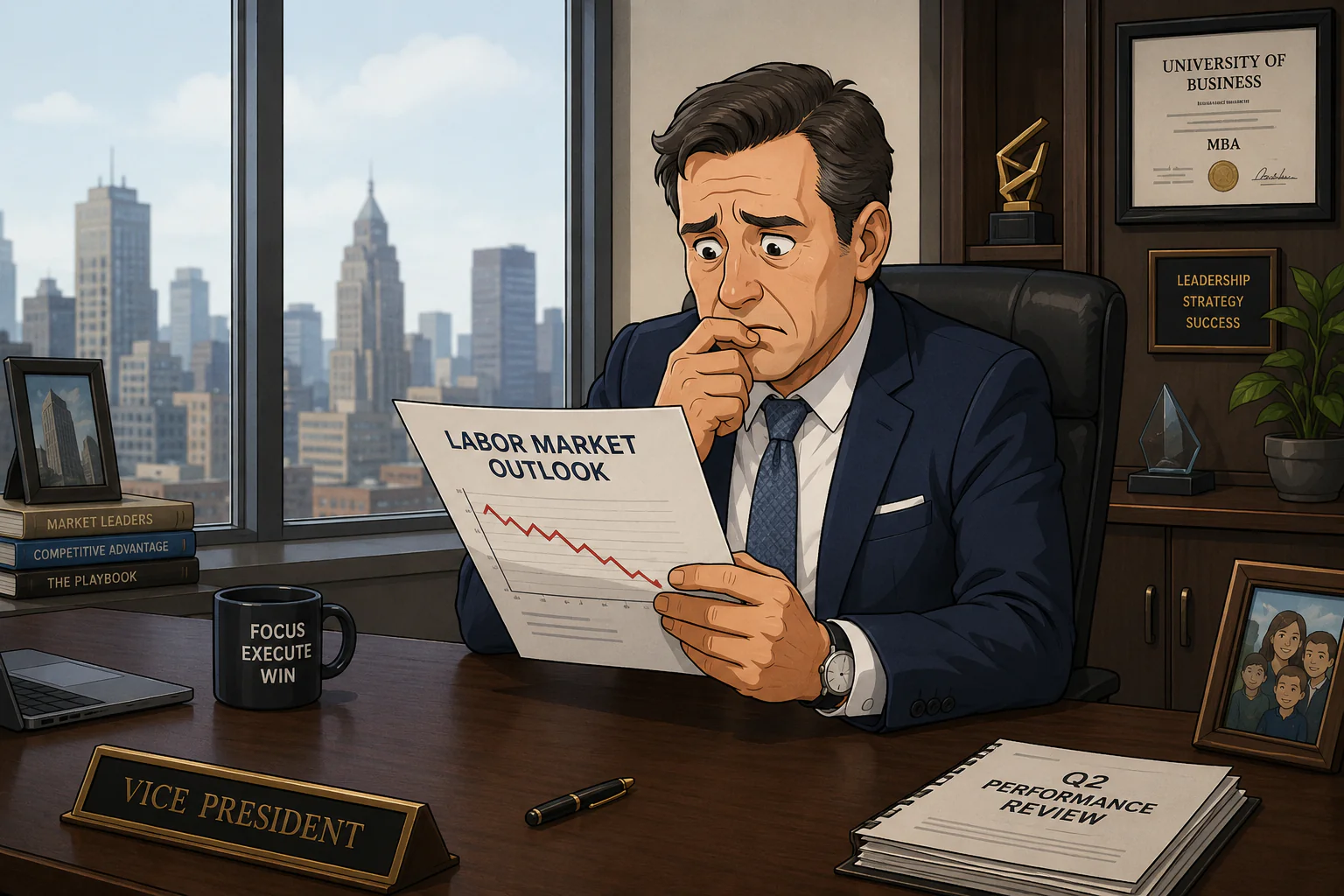
High Earners are More Scared Than Low Earners. They Should Be.
There's a weird thing happening in the labor market.
The guys who are supposed to have it figured out, the ones with the six-figure salaries and the titles, are scared. More scared, in some ways, than people earning half what they make.
They should be.
The Uncomfortable Data
White collar job security isn't what it once was.
Payrolls for white collar workers have contracted for over two years straight.
Not a dip. Not a quarter of softness.
Two-plus years of contraction in professional and business services employment. According to Aaron Terrazas, a former chief economist at Glassdoor, that kind of sustained decline in knowledge-worker jobs is without precedent outside of an actual recession.
Job postings for professional roles fell by something like 35% between early 2023 and early 2025. Postings for software developers, business analysts, and market researchers ran nearly double that rate.
At the same time, quit rates among white-collar workers are at or near record lows.
Nobody's jumping ship. When workers stop voluntarily leaving jobs, it usually means they don't think they'll land somewhere better.
Why Higher Earners Are Exposed
The narrative we used to hear is that blue-collar workers are the vulnerable ones. Knowledge work has been on the grow for decades and in many sectors, impregnable.
But nowadays, the story is running the other direction.
The professional unemployment rate has climbed to levels above manufacturing unemployment. That hasn't happened in a very long time. One in four Americans who lost their jobs in 2024 worked in professional and business services.
There's a couple reasons for that. Some of it is AI. Companies have been explicit about using it to thin out middle layers of knowledge work, even though the returns from AI are suspect. Some of it is a hangover from pandemic over-hiring. Companies brought on a lot of expensive headcount between 2020 and 2022, and they've spent the last two years correcting that. Some of it is AI being used as cover for what would have happened anyway because of business circumstances for the employer.
But what matters to guys our age is that when higher earners get laid off, they take a beating on the way back in. If they get back in.
Studies on displaced workers show them getting 5% to 15% lower in pay than comparable workers who kept their jobs. And for older workers, re-employment takes longer and the pay cuts tend to be larger.
A 12-month earnings gap at $150,000 a year is bad enough. The knock-on problem is that it also means five or ten years of retirement savings progress are gone.

The Plan B Problem
Most of us have a Plan B sitting in the back of our heads. Mine used to be some version of "I'll just work a few more years if I need to." It sounded reasonable. It felt reasonable.
Problem is, the data says roughly half of retirees exit the workforce earlier than they planned. Layoffs. Bad health. Caregiving for parents.
It stacks up.
If you're 55 today thinking you'll work until 67, the odds say you'll get maybe 6 to 9 of those years. Maybe fewer.
So a Plan B that assumes uninterrupted employment until 65 or 67 is a plan that requires a lot of things to go right.
Things that often don't.
What This is Telling You
I'm not a total Doomer.
I don't think a wholesale implosion of white-collar work is imminent, or that everyone in a professional job is about to get laid off.
But the fact is, there is a structural change happening in professional employment and I'm not so sure the folks most exposed are ready for it.
I suspect the guys who should be thinking hardest about this are exactly the guys who feel most insulated. They've spent their careers building expertise in a specific domain, inside a specific organization, inside a specific industry.
And we were taught that loyalty and expertise get rewarded.
But we both know that's been a one-sided deal for a couple decades now. And somewhere in HR or Finance, there's a spreadsheet that decides just where each employee's cost/benefit boundary is. And sooner or later, most of us will end up on the wrong side of that boundary.

Dig Your Well Before You're Thirsty
The problem with an exit plan is that most of us don't build one until we need it. And by then, you're building it while you're backs against a wall, which is the worst time.
So I'm suggesting you get ahead of the problem.
Not quitting your job. Not blowing up your life. Not some dramatic pivot.
But starting to build something parallel.
A skill set, a side income, a network outside your employer's walls. Something that gives you options if your employer decides your number's up.
Maybe that's a freelance consulting gig using the expertise you've built. Maybe it's content, or e-commerce, or affiliate income. For some, like me, it's a network marketing model built on products we believe in. That's one of the things I write about here.
The model matters less than the mindset shift. The shift is from "my employer is my financial plan" to "my employer is a vendor that pays me, and I'd like to have other vendors."
That shift takes time. It takes building while you still have a paycheck. But it's a thousand times easier to build when you're employed than when you're not.
One More Thing.
If you're in the top third of earners, you've done a lot of things right.
But the retirement math is also real. And the job market data is real. And the gap between "I feel secure" and "I have options" is wider than most of us want to admit.
The guys who will land well through whatever the next few years look like aren't the ones with the most impressive resumes. They're the ones who didn't wait until they needed an exit to start building one.
If you want a framework for where to start, the UnFck Your Retirement guide covers the basics: income gap math, what an actual late-stage plan looks like, and some of the moves I've made myself. It's free and there's no pitch buried in it.
Do You Have a Retirement Gap?
Most men don’t know the real number.
You may be closer than you think.
Or further behind than you want to admit.
Either way, guessing won’t help.
Use my free Retirement Gap Calculator to get a clearer picture of how much monthly income you may need to create before retirement.

Copyright © Steve Norris | MissingComma.net | All Rights Reserved | Privacy Policy | Cookie Policy